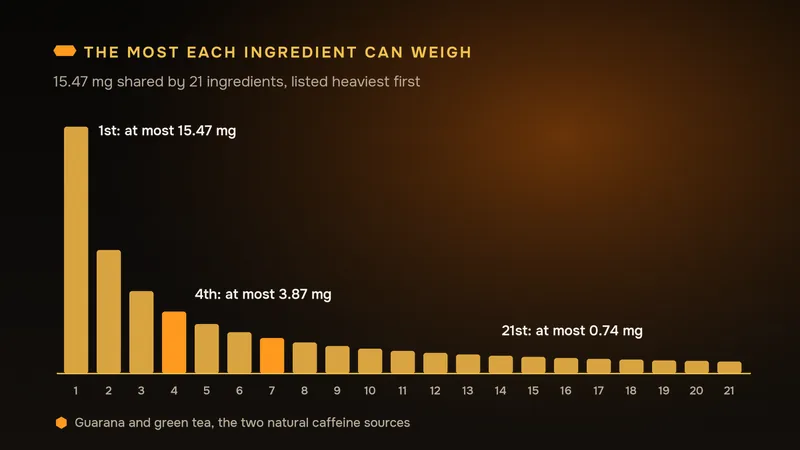
The Honey Force panel gives chromium its own line and amount. Then comes a single figure, 15.47 mg, followed by a paragraph of 21 names. That paragraph is a proprietary blend, and most people read it as a list of mysteries. It is more informative than that. This article shows what can be worked out from a blend, using nothing but the label and division.
The rule that makes it possible
The FDA’s labeling guide says a proprietary blend must show the total weight of its ingredients and list them “in descending order of predominance by weight”. Heaviest first, lightest last. The individual weights may be withheld, but the order may not be shuffled.
Order plus a total is enough to set limits.
The ceiling
Take the ingredient in fourth place. Three ingredients weigh at least as much as it does. If it weighed more than a quarter of the blend, those four alone would exceed the total. So the fourth ingredient can be at most the total divided by four. The same reasoning gives every position its ceiling: total divided by position.
| Ingredient | Position | Sum | At most |
|---|---|---|---|
| Maca root extract | 1 | 15.47 ÷ 1 | 15.47 mg |
| African mango seed extract | 2 | 15.47 ÷ 2 | 7.74 mg |
| Grape seed extract | 3 | 15.47 ÷ 3 | 5.16 mg |
| Guarana seed extract | 4 | 15.47 ÷ 4 | 3.87 mg |
| Green tea leaf extract | 7 | 15.47 ÷ 7 | 2.21 mg |
| Ginseng root extract | 12 | 15.47 ÷ 12 | 1.29 mg |
| L-arginine | 16 | 15.47 ÷ 16 | 0.97 mg |
| Monoammonium glycyrrhizinate | 18 | 15.47 ÷ 18 | 0.86 mg |
| L-carnitine HCl | 21 | 15.47 ÷ 21 | 0.74 mg |
Scroll the table sideways for the remaining columns.
The floor, which exists only at the top
The first ingredient is the heaviest, so it cannot weigh less than an even share. 15.47 mg split 21 ways is about 0.74 mg, so maca is somewhere between 0.73 mg and the whole 15.47 mg. For every other position the floor is, in principle, close to zero: a label could list twenty trace ingredients after one dominant one and still be in order.
Putting the ceilings to work: caffeine
Guarana and green tea naturally contain caffeine, and the label gives no caffeine figure. The ceilings give a worst case. Guarana, fourth, is at most 3.87 mg. Green tea, seventh, is at most 2.21 mg. If both extracts were pure caffeine, which they are not, a dropperful would hold 6.08 mg at most.
The FDA cites 400 milligrams a day as an amount not generally associated with negative effects for most adults, and gives 2 to 15 milligrams as typical for a cup of decaf coffee. So the most caffeine a serving of Honey Force could contain is in decaf territory. Someone avoiding caffeine entirely should still know the two sources are there.
The footnote marks
Ten ingredients carry a caret, which the label explains as “sourced from a concentrate with a 20:1 extract equivalent”, and African mango carries a mark for 10:1. A 20:1 concentrate is made by reducing twenty parts of plant to one part of extract.
This invites a tempting sum: multiply the extract by twenty and quote the “equivalent”. Do it for the whole blend and you get 309.4 mg of starting material at the very most, assuming every milligram were a 20:1 extract, which the label itself rules out since ten ingredients have no mark. The equivalent is a statement about how an extract was made. It is not a second, larger dose.
Scale
A serving is 1 ml. Taking a millilitre of a water-based liquid as about a gram, the blend is roughly 1.5% of what is in the dropper. Over a 30-serving bottle the blend adds up to 464.1 mg, a little under half a gram, and the chromium to 210 mcg.
None of that is a judgement. Small amounts are what the label states, and the label does not pair them with any claim of effect. The point is to know the size of what you are buying.
What a blend can never tell you
- The actual amount of any single ingredient other than chromium.
- Whether the amounts match those used in any study of that ingredient. Without a figure, no comparison is possible.
- The strength of an extract in terms of its active compounds. A ratio describes the process, not the content.
- Anything about ingredients that are not listed. If it is not on the panel or among the other ingredients, the label does not claim it.
If you need exact amounts, ask the seller at [email protected], and treat an answer that is not in writing as no answer.
What this page is based on
- The product: the Honey Force label artwork and order page, the seller’s contact, returns and terms pages and the BuyGoods checkout of each pack, all read on November 27, 2026.
- Reference: U.S. Food and Drug Administration. Dietary Supplement Labeling Guide: Chapter IV. Nutrition Labeling.
- Reference: U.S. Food and Drug Administration. Spilling the Beans: How Much Caffeine Is Too Much?.
- Reference: National Center for Complementary and Integrative Health. Green Tea: Usefulness and Safety.
- Calculated here: pack totals, cost per day, the Daily Value check, the blend ceilings and every pack-to-pack comparison are our own arithmetic on the label and the prices above.