Honey Force ingredients and label
The whole panel as text, one percentage checked, and what a proprietary blend lets you work out.
The Supplement Facts panel
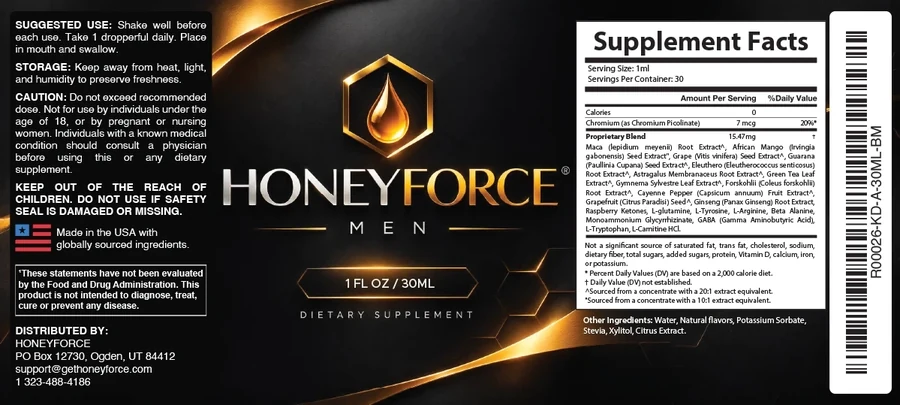
This is the panel from the flat label artwork, typed out so it can be read on any screen and searched. The footnote marks are the label’s own.
| Supplement Facts | Amount per serving | % Daily Value |
|---|---|---|
| Calories | 0 | |
| Chromium (as Chromium Picolinate) | 7 mcg | 20%* |
| Proprietary Blend | 15.47 mg | † |
| Maca (lepidium meyenii) Root Extract^, African Mango (Irvingia gabonensis) Seed Extract", Grape (Vitis vinifera) Seed Extract^, Guarana (Paullinia Cupana) Seed Extract^, Eleuthero (Eleutherococcus senticosus) Root Extract^, Astragalus Membranaceus Root Extract^, Green Tea Leaf Extract^, Gymnema Sylvestre Leaf Extract^, Forskohlii (Coleus forskohlii) Root Extract^, Cayenne Pepper (Capsicum annuum) Fruit Extract^, Grapefruit (Citrus Paradisi) Seed^, Ginseng (Panax Ginseng) Root Extract, Raspberry Ketones, L-glutamine, L-Tyrosine, L-Arginine, Beta Alanine, Monoammonium Glycyrrhizinate, GABA (Gamma Aminobutyric Acid), L-Tryptophan, L-Carnitine HCl. | ||
How to read this panel
The panel has two kinds of line. Chromium is a nutrient with an official Daily Value, so the label gives it an amount and a percentage. Everything else sits inside a proprietary blend, where the law asks for one total weight and a list in descending order by weight, as the FDA’s labeling guide explains. The amounts of the individual blend ingredients are the maker’s to keep.
A serving is 1 ml. The blend is 15.47 mg, so it makes up about 1.5% of that millilitre by weight if you take a millilitre as roughly a gram; the rest is water, flavouring, sweeteners and preservative.
Checking the one percentage
Labels can carry typing errors, so we divide for ourselves. The FDA’s table of Daily Values lists 35 mcg for chromium.
| Line | In one dropperful | FDA Daily Value (adults) | Our division | Label prints |
|---|---|---|---|---|
| Chromium | 7 mcg | 35 mcg | 20% | 20% |
| Proprietary blend | 15.47 mg | None set | Nothing to divide by | † on the label |
Scroll the table sideways for the remaining columns.
The blend, ingredient by ingredient
Here are the 21 blend ingredients in the label’s order. The figure on the right is not the amount in the product. It is a ceiling we calculated: because the list runs from heaviest to lightest, the ingredient in position k cannot weigh more than 15.47 mg divided by k. The first ingredient, being the heaviest, must also weigh at least an even share, 0.73 mg.
- Maca root extractExtract of a root vegetable from the Andes; marked as a 20:1 concentrateat most 15.47 mg
- African mango seed extractExtract of the seed of a West African fruit tree; marked as a 10:1 concentrateat most 7.74 mg
- Grape seed extractExtract of wine-grape seeds; marked as a 20:1 concentrateat most 5.16 mg
- Guarana seed extractExtract of an Amazonian seed that naturally contains caffeine; marked as a 20:1 concentrateat most 3.87 mg
- Eleuthero root extractExtract of the root of a woody shrub; marked as a 20:1 concentrateat most 3.10 mg
- Astragalus root extractExtract of the root of a plant in the pea family; marked as a 20:1 concentrateat most 2.58 mg
- Green tea leaf extractExtract of tea leaves, a natural source of caffeine; marked as a 20:1 concentrateat most 2.21 mg
- Gymnema sylvestre leaf extractExtract of the leaves of a climbing plant; marked as a 20:1 concentrateat most 1.94 mg
- Forskohlii root extractExtract of the root of a plant in the mint family; marked as a 20:1 concentrateat most 1.72 mg
- Cayenne pepper fruit extractExtract of the chili pepper fruit; marked as a 20:1 concentrateat most 1.55 mg
- Grapefruit seedThe seed of the citrus fruit; marked as a 20:1 concentrateat most 1.41 mg
- Ginseng root extractExtract of Asian ginseng root; no concentrate markat most 1.29 mg
- Raspberry ketonesAn aroma compound of raspberries; no concentrate markat most 1.19 mg
- L-glutamineAn amino acid; no concentrate markat most 1.11 mg
- L-tyrosineAn amino acid; no concentrate markat most 1.04 mg
- L-arginineAn amino acid; no concentrate markat most 0.97 mg
- Beta-alanineAn amino acid; no concentrate markat most 0.91 mg
- Monoammonium glycyrrhizinateA sweet-tasting salt of glycyrrhizic acid, the compound found in licorice root; no concentrate markat most 0.86 mg
- GABAGamma-aminobutyric acid, an amino acid compound; no concentrate markat most 0.82 mg
- L-tryptophanAn amino acid; no concentrate markat most 0.78 mg
- L-carnitine HClA compound the body makes from amino acids; no concentrate markat most 0.74 mg
Ten ingredients carry the label’s 20:1 concentrate mark and one carries the 10:1 mark. A 20:1 concentrate means twenty parts of plant were reduced to one part of extract. Even if the whole blend were a 20:1 concentrate, a serving would correspond to at most 309.4 mg of starting plant material.
Four lines worth a closer look
Chromium (as chromium picolinate)
What the label says. 7 mcg per serving, 20% of the Daily Value. Over a bottle that adds up to 210 mcg.
What general references say. MedlinePlus calls chromium an essential element that the body does not make, involved in the breakdown of fats and carbohydrates, and names meat, whole grains and some fruits, vegetables and spices as sources. It gives an adequate intake of 35 mcg a day for men aged 14 to 50 and 30 mcg for men of 51 and over, and notes that toxicity is uncommon.
What cannot be concluded. That 7 mcg does anything noticeable for a man who already eats a varied diet. It is a fifth of a day’s reference amount, no more.
Guarana seed and green tea leaf extracts
What the label says. Positions four and seven in the blend, both marked 20:1. No caffeine amount is printed.
What general references say. Both plants naturally contain caffeine; NCCIH notes that green tea contains caffeine, and the FDA lists guarana among caffeine-containing ingredients and cites 400 milligrams a day as an amount not generally associated with negative effects for most adults.
What cannot be concluded. The actual caffeine content. We can only bound it: guarana is at most 3.87 mg and green tea at most 2.21 mg, so the two together cannot exceed 6.08 mg even if they were caffeine and nothing else. That is a trace next to a cup of coffee, but it is not zero.
Monoammonium glycyrrhizinate
What the label says. Position eighteen, so at most 0.86 mg per serving. No concentrate mark.
What general references say. It is a salt of glycyrrhizic acid, the sweet compound of licorice root. NCCIH says glycyrrhizin can cause serious adverse effects when consumed in large amounts or in the long term, and that even small amounts have been linked to severe effects in people with hypertension or heart or kidney conditions.
What cannot be concluded. Whether an amount this small matters for you. If you have high blood pressure or heart or kidney trouble, that is a question for your doctor, with this list in hand.
The amino acids
What the label says. L-glutamine, L-tyrosine, L-arginine, beta-alanine, GABA, L-tryptophan and L-carnitine HCl occupy positions fourteen to twenty-one, apart from the licorice compound. The largest any of them can be is 1.11 mg.
What general references say. Most of these are amino acids, the building blocks of protein, which an ordinary diet supplies by the gram, not by the milligram.
What cannot be concluded. Any effect from sub-milligram amounts. The label claims none, and neither do we.
Other ingredients
Below the panel the label lists: water, natural flavors, potassium sorbate, stevia, xylitol, citrus extract. Water is the carrier. Natural flavors and citrus extract shape the taste, stevia and xylitol sweeten it, and potassium sorbate is a preservative. The FDA explains that this list is where a label declares everything not counted as a dietary ingredient.
The label artwork has no allergen statement and no vegetarian, vegan, gluten-free or non-GMO wording, so this website makes none of those claims.
Storage
“Keep away from heat, light, and humidity to preserve freshness.” The label also says to keep the bottle out of the reach of children and not to use it if the safety seal is damaged or missing.
What this page is based on
- The product: the Honey Force label artwork and order page, the seller’s contact, returns and terms pages and the BuyGoods checkout of each pack, all read on November 27, 2026.
- Reference: U.S. Food and Drug Administration. Dietary Supplement Labeling Guide: Chapter IV. Nutrition Labeling.
- Reference: U.S. Food and Drug Administration. Daily Value on the Nutrition and Supplement Facts Labels.
- Reference: U.S. Food and Drug Administration. Questions and Answers on Dietary Supplements.
- Reference: MedlinePlus Medical Encyclopedia. Chromium in diet.
- Reference: U.S. Food and Drug Administration. Spilling the Beans: How Much Caffeine Is Too Much?.
- Reference: National Center for Complementary and Integrative Health. Green Tea: Usefulness and Safety.
- Reference: National Center for Complementary and Integrative Health. Licorice Root: Usefulness and Safety.
- Calculated here: pack totals, cost per day, the Daily Value check, the blend ceilings and every pack-to-pack comparison are our own arithmetic on the label and the prices above.